
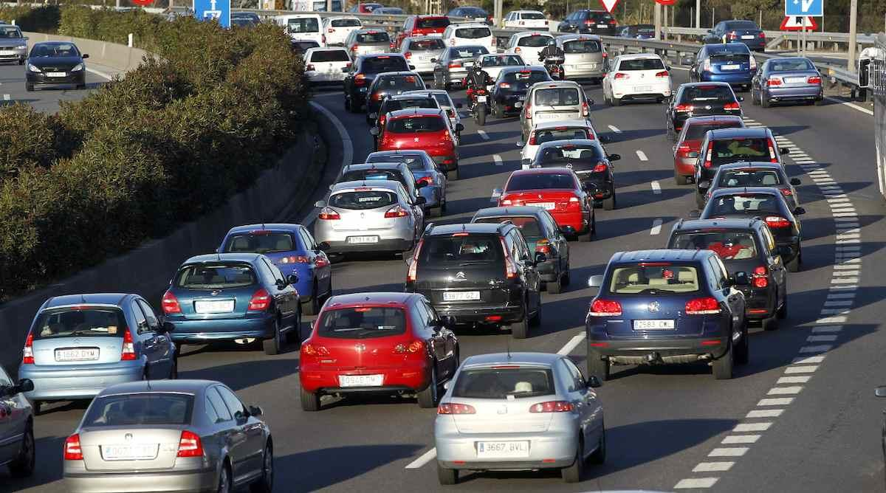
Human mobility is a process to which we devote a great deal of analytical effort. A problem: Transport is responsible for 25% of CO2 emissions, 70% of which comes from road traffic. 33% of workers spend more than an hour commuting to and from work every day. A need: transport bring us closer to other humans, to facilities, goods, services, leisure. And we ask ourselves, what would happen if…?
From Description to Simulation of Human Mobility
Mobility can be analyzed, modeled, and… simulated, in search of scenarios, new realities. This simulation capability represents the most advanced level in mobility data analysis, following this hierarchy:
1 description -> 2 estimation -> 3 prediction -> 4 simulation
- Mobility description: data from field sources, such as manual counts, cameras or indirect ones like sensors, wi-fi antennas, aggregates derived from phone antennas, GPS, geolocation from mobile apps
- Mobility estimation: refers to inter/extrapolation processes from descriptive data samples to reach either a broader, more complete universe, or different conditions — temporal, for example
- Mobility prediction: extrapolation to parameter values not contained in descriptive data, typically time — for example, what will traffic flow be like on the stretch tomorrow afternoon?
- Mobility simulation: complex systems that describe, predict, and allow for the simulation of mobility under scenarios, combinations of advanced parameters that don’t exist in historical reality (descriptive) and are too complex (multiple interacting variables) to reduce to prediction problems
In this article, we focus on agent-based mobility simulation methods supported by Monte Carlo techniques, which we believe are the best approach for several reasons explained below.
The Need to Simulate Mobility
Simulating human behavior is an analytical approach that provides three types of benefits over other methods:
- Mobility estimation with high coverage, since it allows modeling a very large analysis universe, such as an entire country, at an affordable cost
- High spatial accuracy, as the simulation is natively developed on road topology — unlike, for example, mobile phone data that is later interpolated onto the road network
- Simulation functionality and scenario analysis derived from the very nature of simulation. Since estimates are built via simulation, it’s possible to simulate natively. This benefit is complemented by the independence from origin-destination matrices inherent in agent-based simulation, which we’ll explain later
The Opportunity: More Data Than Ever to Simulate Mobility
The methodology presented here wouldn’t be possible without open data. Today, we can access extensive resources of high-quality, open, accessible data… 99% of the data that feeds the simulation is open:
- Population registry, census
- Cadastre
- INE survey microdata: EPA, ECV, EPF, Establishment occupancy surveys and tourist origin
- Transport hub flows
- Road network and points of interest from Open Street Maps, IGN
- Ministry of Transport, open mobility big data
The remaining 1% are proprietary sources we use to complete, enhance, or personalize modeling when applied to a specific area or context. These include methods for measuring traffic or presence — GPS, phone antennas, wifi, cameras — as well as directories of points of interest or attraction — tourism, stores, restaurants.
All this data requires intense preprocessing before feeding the simulation, especially the road network map. At unica360 we benefit from having previously modeled where the population lives, works, and goes for leisure, health, education, shopping, types of neighborhoods, lifestyles, making this preprocessing fast, accurate, and reliable.
Topology Construction
The space in which simulated trips happen has a graph structure — that is, a set of nodes and a set of links connecting one node to another. We call it topology because it contains circulation logic synthesized from:
- Possibility of traveling on foot or by vehicle
- Direction of traffic flow on different road segments
- Possibility of exiting an intersection via one segment or another (based on signage)
- Intersections with or without physical crossing
To generate realistic simulations, it’s essential to account for these aspects and define a topology that represents reality as faithfully as possible. This has required processes that integrate data from the used maps and end up defining sets of nodes and links between them, with attributes such as:
- Number of lanes
- Road type
- Maximum allowed speed
- Number of intersections
These characteristics form the basis for calculating the time needed to travel from one node to another via a given segment.
Agent-Based Mobility Simulation Methodology
Simulation is based on combining Monte Carlo methods with an agent-based approach:
Monte Carlo Methods
These are techniques widely used in fields like Statistical Physics and Complex Systems Physics, among others.
In the literature, the concept of Monte Carlo method is often distinguished from simulations using it — the former is simply a technique to approximate probabilities resulting from complex processes that make it difficult or impossible to explicitly calculate the system’s probability law. This is done through massive computations using pseudorandom numbers plugged into system equations to then extract sample statistics.
This methodology is especially useful in simulating dynamics involving large numbers of elements that interact with each other or the environment in non-trivial ways. In such cases, the complexity of the equations makes it unfeasible to generate symbolic (equation-based) representations of their collective dynamics — hence the frequent use of Monte Carlo techniques for approximate resolution.
Specifically, in this case, an Agent-Based Simulation has been carried out — these agents represent individuals who evolve, make decisions, trace paths, and interact with each other. It is clearly a direct application of the explained techniques.
Agent-Based Simulations
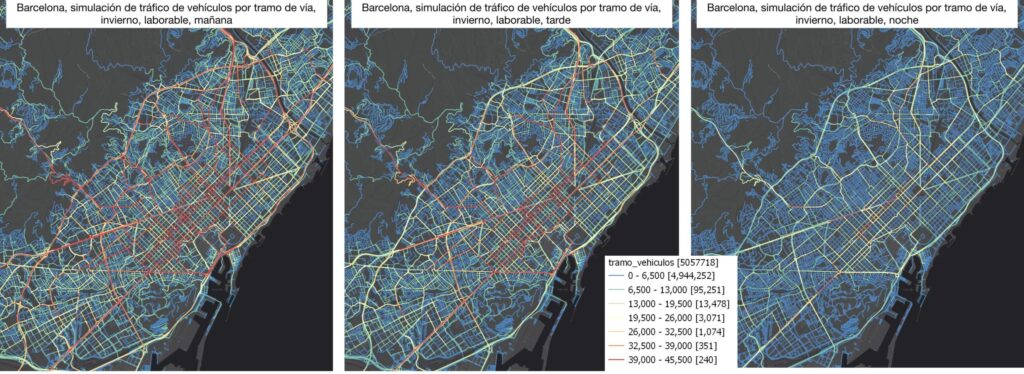
Once all the components described above were developed, we created the code in which they operate under the logic of Agent-Based Simulation, representing people whose positions evolve within a space defined as a directed graph, with the aim of accumulating agent steps through the graph links (each uniquely associated with a road segment), ultimately generating an intensity pattern per segment.
In other words, the routes generated by agents during their trips are aggregated at the segment level, producing an index of steps per segment.
A definitive advantage of this methodology is that it doesn’t rely on pre-defined origin-destination matrices, although it can leverage them. This independence provides two major benefits:
- it allows for traffic simulation and estimation anywhere, anytime
- it enables real simulation when parameters affecting mobility matrices themselves are modified
- agent-based simulation based on emission and attraction data can even be used to estimate and generate new origin-destination matrices where none exist
Three Simulation Steps
- Decision to initiate a trip from a graph node (origin)
- Decision to select a destination node on the graph
- Decision of the path to take between both nodes
Validation, Elevation, and Calibration
Finally, data from more or less direct observations is incorporated, mainly point measurements from cameras, induction loops, but also estimates from anonymized mobile phone data or wifi antenna sensors.
With this, we validate results — in simplified terms, we operate with a mean absolute error (MAE) ~15% — and elevate to actual vehicle counts.
Model Outputs: How It’s Used
When we talk about simulation in this context, we actually refer to an entire codebase that prepares data, runs routing algorithms — the three simulation steps — aggregates routes by segment, and calibrates results. It is, therefore, a software tool, but one that requires qualified parameterization for each execution, depending on input data and execution goals.
There are currently two ways to use the simulation:
- Dataset with national coverage, as an annual snapshot, under annual usage license, currently available for Spain, Portugal, Mexico and breaking down by:
- winter vs summer
- weekdays vs weekends
- time slots
- Simulator as a codebase that can be applied in different contexts, with standardized but qualified parameterization to adapt the system to the context or use case.
- Dataset with national coverage, as an annual snapshot, under annual usage license, currently available for Spain, Portugal, Mexico and breaking down by:
Applications of Mobility Simulation
- Dataset with national coverage, as an annual snapshot, under annual usage license. Some common uses include:
- Traffic flow to business entrances like hypermarkets, malls, gyms
- Traffic flow around outdoor advertising supports, OOH
- Traffic flow as an indicator of need, demand for EV charging points, gas stations
- Input variables for predictive models, extrapolating sensor measurements like air quality, noise levels
- Simulator as a codebase to be parameterized and executed per use case:
- creating a traffic map of a municipality or region with higher local precision
- simulating pedestrianization, calming, or lane-reduction scenarios
- simulating new infrastructure scenarios — highway access, bridges…
This approach is now the foundation of our mobility simulation services, applied to real urban planning and pedestrianization projects.
In the post Vehicle traffic simulation, applications in location intelligence you can find more info about applying vehicle mobility simulation to location intelligence projects. And if you want to know more, you can reach out or schedule a meeting.